 How-to
How Do You Claim Travel Insurance for Canceled Flights?
Last Updated: November 19, 2026
Quick Summary
To claim travel insurance for canceled flights, confirm your cancellation is a covered reason, notify your insurer within 24 to 48 hours, and gather supporting documents like receipts, your itinerary, and the airline's written cancellation statement before filing online or by app. Claim only your remaining non-refundable losses and disclose any airline voucher, refund, or rebooking on the claim form.
- Trip cancellation insurance reimburses prepaid, non-refundable costs and works separately from an airline refund.
- Notify the insurer within 24 to 48 hours of cancellation, even before your documents are ready.
- Get the airline's written cancellation statement with a reason code before you file.
- Accept the airline's offer first, then claim only the remaining non-refundable losses from insurance.
- A denied claim can be appealed within the stated window, or escalated to your state insurance regulator.
Table of Contents
- Start Your Travel Insurance Claim for a Canceled Flight
- Supporting Documents for a Flight Cancellation Claim
- Get an Airline Flight Cancellation Statement Before You File
- Travel Insurance Claim Filing Timeline: Deadlines That Decide Your Payout
- Step-by-Step: How to File a Travel Insurance Claim Online or by App
- Airline Voucher vs. Insurance Claim: Which to Accept First
- When Force Majeure and Policy Exclusions Block Your Claim
- Need Help With a Canceled Flight Claim? Call Prime Luxury Travel
- Frequently Asked Questions
Start Your Travel Insurance Claim for a Canceled Flight
A canceled flight can upend weeks of planning, but knowing how to claim travel insurance is straightforward if you act quickly. This guide walks you through how to claim travel insurance for canceled flights, step by step.
First, know the difference: trip cancellation insurance reimburses your prepaid, non-refundable costs when a covered event stops your trip. It is not an airline refund, the two work separately.
Confirm your policy covers the cancellation
Before you file anything, check that your reason for cancellation is a covered reason. Most travel protection plans list these clearly in the policy documents.
Common covered reasons include:
- Illness or injury that stops you traveling
- A death in the family
- Severe weather that cancels flights
Read the policy exclusions too. A change of mind and fear of travel are rarely covered. If your reason is not on the covered list, the insurer will likely deny the claim.
Supporting Documents for a Flight Cancellation Claim
Paperwork is central to the claim. Missing supporting documents is a common mistake that adds weeks to the claim status.
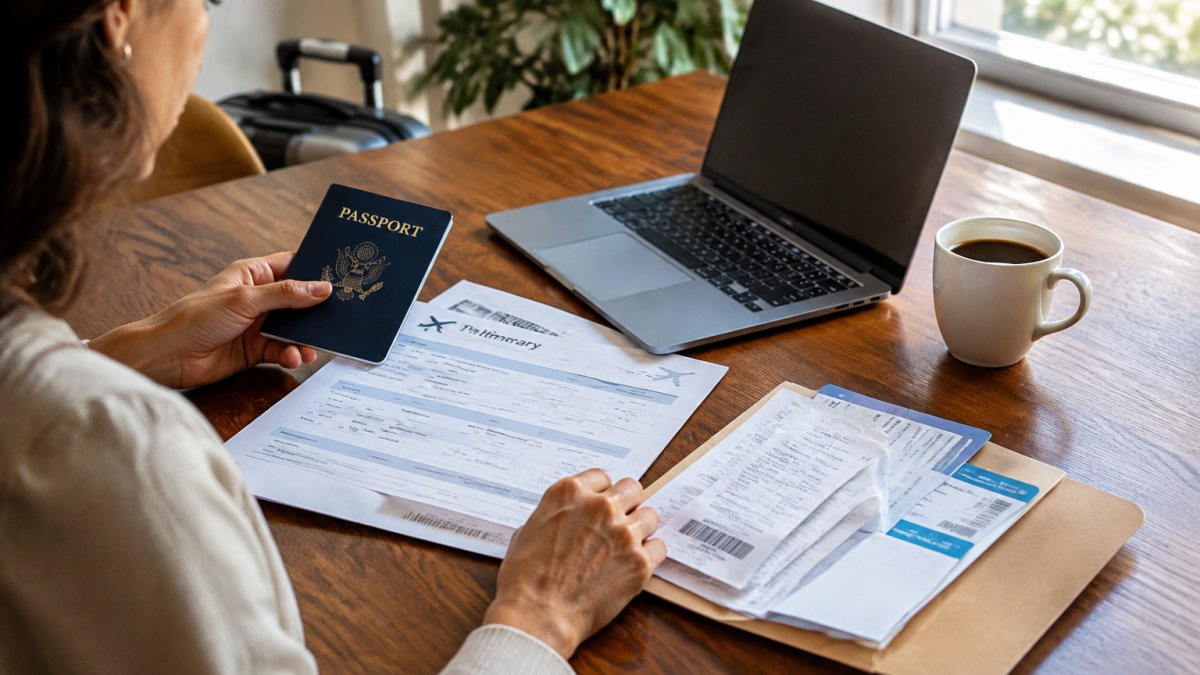
Build a documentation checklist before you start:
- Proof of loss: a written summary of what you lost and the amount
- Itemized receipts for every non-refundable expense
- Flight itinerary and booking confirmation
Keep digital copies of everything, and scan receipts at booking so you are never hunting for paper later.
Get an Airline Flight Cancellation Statement Before You File
Do not file until you have the airline's written cancellation statement. It proves the triggering event happened, when, and that it was outside your control.
An airline flight cancellation statement is the carrier's official confirmation that your flight was canceled, with the reason code and date. Insurers use it to match your claim against the covered-reason list. "Canceled due to weather" maps to a covered severe-weather reason; "canceled due to crew scheduling" may not.
What the statement should contain
Before you leave the airport, confirm the document includes:
- Your full name and booking reference (PNR)
- The flight number, route, and scheduled departure date
- The word "canceled" and the date the cancellation was decided
If any are missing, ask the desk agent to add them. A one-line email saying "your flight was canceled" without a reason code is weaker evidence.
How to request it when the desk is overwhelmed
A mass cancellation, a storm, strike, or IT outage, is exactly when the airport desk is least able to help. Work the channels in this order:
- Airline app or website. Many airlines post a cancellation notice under your booking, sometimes as a downloadable document, often the fastest route.
- Email confirmation. The cancellation email sent to your booking address is acceptable proof in most cases; save the full message with headers, not a screenshot.
- Customer service phone line. Ask the agent to email you the statement while you are on the call, and note the agent's name and call reference.
- Airport desk as a last resort. If you are already there, ask for the printout before you leave the terminal.
If the airline will not put it in writing
Some carriers, particularly low-cost airlines, resist issuing formal statements and point you to a generic "flight status" page. In that case:
- Save a dated screenshot of the flight-status page showing the cancellation.
- Forward the airline's cancellation email to yourself and keep the original.
- Ask the insurer, in writing, whether the app notice or email is acceptable in place of a formal statement. Get the answer before you file so you are not guessing.
Watch out: a verbal confirmation at the gate will not help your file. Ask the agent to put the same words in an email or app message before you walk away.
Why this document changes your claim outcome
Without a written statement, the insurer may treat your claim as unverified and request more information, stalling the claim submission process and possibly pushing you past the policy's document deadline. With it, the adjuster can confirm the covered event on day one.
Travel Insurance Claim Filing Timeline: Deadlines That Decide Your Payout
Time is your biggest risk in this process. Miss a deadline and a valid claim can be denied outright.
A practical rule: notify the insurer within 24 to 48 hours of the cancellation, even if your documents are not ready.
| Stage | What to do | Timing |
|---|---|---|
| Notice | Tell the insurer the trip was canceled | Within 1-2 days |
| Statement | Get the airline cancellation statement | Same day as cancellation |
| Documents | Collect receipts, itinerary, proof of loss | Within 1-2 weeks |
| Submission | File the claim form and documents | Within policy deadline |
| Follow-up | Check claim status and respond to requests | Weekly until paid |
Watch out: waiting until you return home to file is the most common reason travelers lose a valid claim. Start the clock the day the flight is canceled.
Step-by-Step: How to File a Travel Insurance Claim Online or by App
Here is the full claim submission process, start to finish. Most insurers let you file online or through their app, and doing it digitally is faster.
- Open your policy and confirm the cancellation is a covered reason.
- Notify the insurer by phone or portal within the first day or two.
- Request the airline statement in writing.
- Complete the claim form with exact dates and amounts.
- Upload supporting documents using the app's photo scanner.
- Submit and save your claim number.
- Check claim status weekly and respond to any requests fast.
What to do if your claim is denied
A denied claim is not always final. Read the denial letter and find the exact reason. Then:
- Request the specific policy clause the insurer relied on.
- Supply any missing supporting documents.
- File a formal appeal within the stated window.
Many denials come down to a missing receipt or a reason that was never covered. Fix the first, and appeal the second.
Airline Voucher vs. Insurance Claim: Which to Accept First
Accept the airline's offer, then claim the rest. Travelers often go wrong in one of two directions: they refuse the airline's help and leave compensation on the table, or they accept a voucher and then claim the full loss from insurance, which triggers an offset and a slower, smaller payout.
If you accept a voucher and then claim the full loss from your insurer, the insurer will subtract the voucher's value. You cannot be paid twice for the same loss (HERBERT WINKELMANN, ET AL., APPELLANTS, v. EXCELSIOR INSURANCE COMPANY, RESPONDENT.).
The order of operations that protects your payout
- Take the airline's offer for the flight itself. That means a cash refund where you are legally entitled to one, or a voucher or rebooking where you are not. Get it in writing with a value attached.
- Document what the airline gave you. Save the voucher code, the refund confirmation, or the rebooking email, and note the dollar value or the equivalent.
- Claim only your remaining non-refundable losses from insurance. That is the trip around the flight, prepaid hotels, tours, transfers, and other costs the airline did not cover.
- Disclose the airline compensation on the claim form. Insurers ask; answer accurately and attach the proof. Undisclosed vouchers are a common reason claims get flagged or denied.
This is the airline compensation split most travelers get wrong. The airline covers the flight. Your policy covers the trip around it.
Voucher, refund, or rebooking: what each one does to your claim
The type of airline compensation matters as much as the amount:
- Cash refund. If the airline refunds the ticket, you no longer have a loss on that ticket, so do not claim it. Claim the surrounding non-refundable costs instead.
- Travel voucher or credit. The insurer will typically treat the voucher's face value as compensation and subtract it from your claim. If the voucher expires unused, ask the insurer whether the offset can be reversed, some will, with proof of expiry.
- Rebooking on a later flight. Rebooking is not cash in your pocket, but it removes the flight cost from your loss. Claim the costs caused by the delay or the missed connection, not the flight itself.
What counts as "the same loss"
The offset rule is about the same loss, not every dollar the airline gives you. If the airline refunds your $600 ticket and your policy covers $1,400 in non-refundable hotel and tour costs, the insurer should pay the $1,400, the ticket was never part of the insurance claim.
Watch out: do not sign an airline release or waiver saying you accept the voucher "in full settlement" of all losses before checking what your policy covers. That signature can limit your insurance claim.
Keep a one-page compensation log
Before you file, write a short log: what the airline gave you, the value, the date, and the reference number. Attach it to your claim.
When Force Majeure and Policy Exclusions Block Your Claim
Some cancellations fall into a gray zone. A force majeure clause, sometimes called an "act of God" clause, lets an insurer limit or exclude payouts for extreme events like natural disasters, war, or widespread airline shutdowns.
Check whether your policy treats a force majeure event as covered or excluded. Many standard plans exclude it, while some travel protection plans include it as an add-on.
Other policy exclusions to watch:
- Cancellations caused by a pre-existing condition
- Travel against government advice
- Cancellations you caused or could have avoided
If a force majeure event is the reason, call the insurer before you file. Ask directly whether the event falls under your policy benefits.
Need Help With a Canceled Flight Claim? Call Prime Luxury Travel
A canceled flight is stressful enough without fighting an insurer on your own. Our advisor, Allen Robinson, brings firsthand knowledge of global destinations and a network of world-class partners to every itinerary.
We build seamless, personalized itineraries and give you access to valuable privileges at hundreds of hotels and resorts worldwide. For the broader playbook, our guide on what happens if your flight is canceled walks through the next steps.
If you would rather hand off the stress, read our stress-free luxury travel tips from expert planners. Our breakdown of whether a travel advisor is worth the cost answers that directly. And for ongoing support with rebooking and logistics, see what a luxury travel concierge service offers.
Don't let a canceled flight turn into a lost vacation. Prime Luxury Travel handles the planning, the partners, and the details, so you can focus on the trip itself.
Frequently Asked Questions
What documents do I need to claim travel insurance for a canceled flight?
You will typically need your policy number, the airline flight cancellation statement, your original booking confirmation and flight itinerary, itemized receipts for non-refundable expenses, and proof of any refund or voucher you received. If the cancellation was due to medical reasons, include medical documentation. Keep copies of everything you submit and note the date you sent it, because the travel insurance claim filing timeline depends on when the provider receives your supporting documents for a flight cancellation claim.
How long do I have to file a travel insurance claim after a cancellation?
Most policies set a filing window that starts when the cancellation happens, often 20 to 30 days, though some allow up to 90 days. Missing that window can void your claim even when the cancellation was a covered reason. Check your policy's notice period the day you cancel, submit the claim form as soon as you have the airline flight cancellation statement, and send any missing documents before the deadline rather than waiting to gather everything at once.
Does standard travel insurance cover flight cancellations by the airline?
It depends on the reason for the cancellation and your policy's covered reasons. Mechanical issues, weather that grounds flights, and strikes are commonly covered; a cancellation you choose for personal convenience usually is not. If the airline cancels and refunds you, insurance may only cover the extra non-refundable expenses you cannot recover elsewhere. Read the policy exclusions before you file so you know whether to pursue airline compensation first or start a claim travel insurance request.
What is the difference between trip cancellation and trip interruption insurance?
Trip cancellation reimburses non-refundable expenses when you cancel before departure for a covered reason, such as illness or a flight cancellation that ends the trip. Trip interruption covers costs after you have already left, like returning home early or rebooking a missed connection. Both require proof of loss and documentation. Knowing which benefit applies to your situation helps you complete the right claim form and avoid a denied claim for using the wrong section of your policy.